|
|
The CERN-developed chips transforming
science and society |
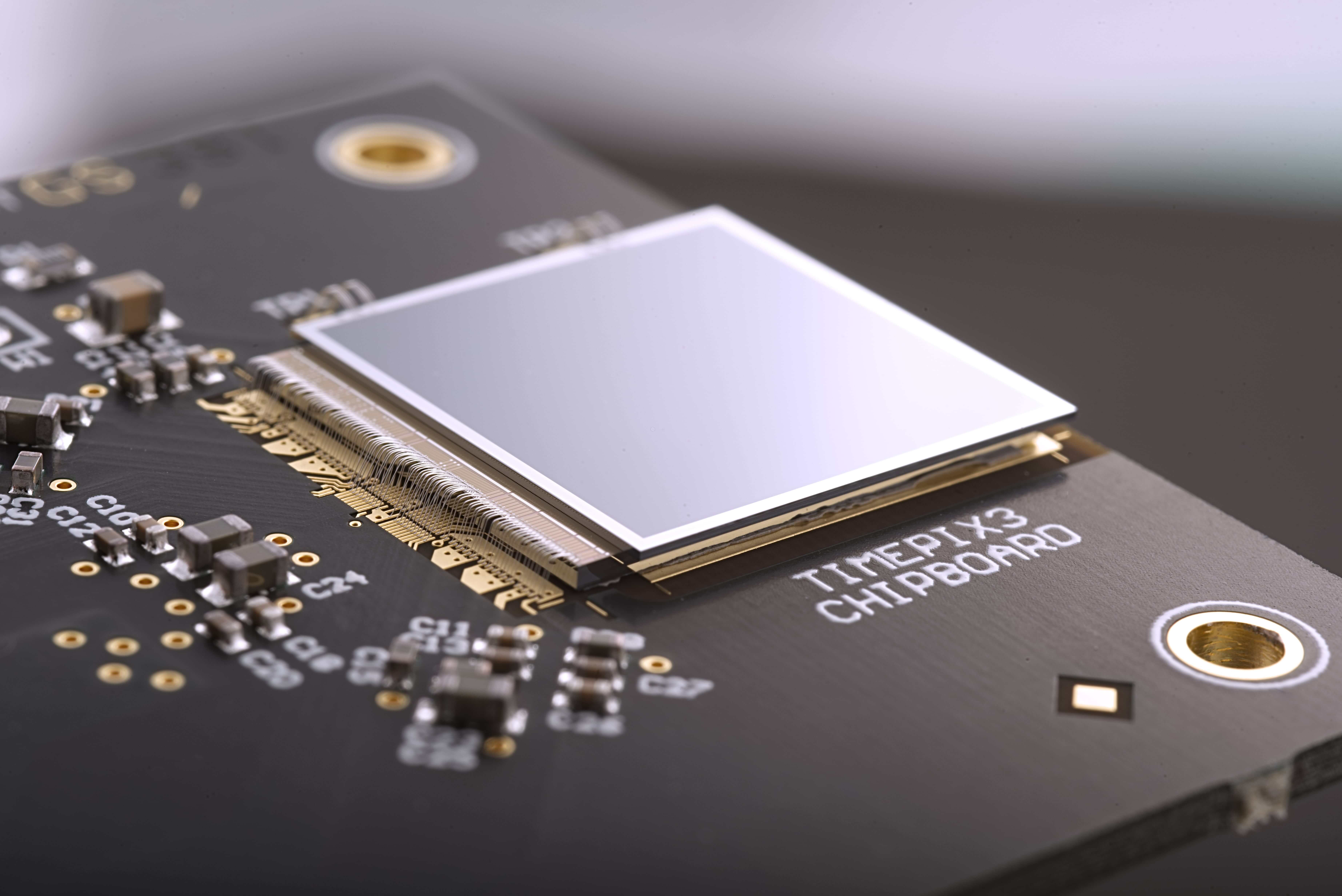
Medical imaging, radiotherapy, space dosimetry, material analysis. These are just a few of the many areas that have been impacted by advanced semiconductor chips developed in recent decades by the Medipix collaborations at CERN in conjunction with over 30 external research institutes.
A symposium held at CERN on 23 September to mark the 20th anniversary of the Medipix3 collaboration showed that Medipix and Timepix still have much in store.
|
|
|
|
|
|
|
|
|
| “No better place to strike quantum conversations”: CERN hosts European Quantum Industry Consortium (QuIC) |
| This year, the annual European Quantum Industry Consortium (QuIC) Business Community Summit was hosted at CERN on 26–27 November. Over the course of two days, participants exchanged views on key strategic topics and engaged in discussions aimed at advancing Europe’s leadership in quantum technologies. |
|
|
|
|
|
|
|
Beamtime applications for space electronics testing at CERN in 2026
|
Companies and research institutes interested in using the HEARTS@CERN high-energy, heavy ion radiation testing and shielding facility for civilian space applications will have another chance in 2026 with a run planned for July or August.
Calls for scientific and commercial users will be made in early 2026, likely around February, with the campaign to take place over 12 days next summer.
The HEARTS@CERN facility has held two successful test campaigns to date, in 2024 and 2025, with over 20 user teams testing and qualifying electronic modules or components for use in space. Previous users include Airbus, Aspina, Axiom Space, Mynaric, TESAT, Thales Alenia Space, The Exploration Company, and Tyvak.
|
|
|
|
|
|
|
|
| PRISMAP completes its final user deliveries |
Coordinated by CERN, PRISMAP, the European Medical Radionuclides Programme, has completed its final deliveries after five years of supporting medical radionuclide research across Europe.
Through five calls, 47 projects from 19 countries were selected, with 23 radionuclides requested, resulting in 159 deliveries. The final shipment, on 19 November 2025, delivered astatine-211 to ICNAS (Portugal) for preclinical glioblastoma studies, with radionuclides supplied by CERN-MEDICIS.
PRISMAP concludes on 31 December 2025, with PRISMAP+ submitted for funding to continue this work in line with Europe’s Beating Cancer Plan.
|
|
|
|
|
|
|
|
| CERN and SuperNode, a collaboration to revolutionise energy transmission |
CERN and Ireland-based SuperNode Ltd have collaborated to create a novel cryostat for superconducting cables. The testing campaign at CERN provided key insights to help with the selection of suitable materials and with refining the cryostat design itself. The joint work resulted in a five-fold increase in cooling station spacing, significantly enhancing operational efficiency and cost.
"Next-generation high-capacity cables will play a vital role for utilities and large energy users, including data centres, by enabling greater power delivery while reducing space needs, emissions, visual footprint, and costs." - John Fitzgerald, CEO of SuperNode.
|
|
|
|
|
|
|
|
| Improving stroke care with CERN’s CAFEIN® |
The European research project TRUSTroke has launched a clinical study of 1,500 patients to develop an AI-based solution using CERN's federated AI platform, CAFEIN®. The project seeks to improve post-stroke patient care as well as improve personalised patient monitoring and stroke progression prediction.
By enabling secure, privacy-preserving collaboration across European institutions, the project seeks to improve post-stroke care through personalised patient monitoring and more accurate prediction of stroke progression. Watch the video to learn how CAFEIN® is transforming stroke care.
Congratulations to the CAFEIN® team, who won the Innovate for Impact in Healthcare Award at the AI for Good Summit last July.
|
|
|
|
|
|
|
|
| CERN and Fusion for Energy sign a collaboration agreement |
|
On 10 September 2025, CERN and Fusion for Energy (F4E) have signed a collaboration agreement to advance scientific research and technological development in areas of common interest. F4E is the European Union organisation managing contributions to ITER, the world’s largest scientific experiment working on fusion energy.
|
|
|
|
|
|
|
|
| How particle accelerators can help improve human health |
Twenty-four students took part in the IFAST Challenge Based Innovation initiative at CERN, working on ambitious and unique technologies that could help tackle real-life problems. The winning team proposed an innovative approach to combat antibiotic resistance using targeted Auger electron therapy.
|
|
|
|
|
|
|
|
| CERN Venture Connect accelerates Europe’s deep-tech startup ecosystem |
The year 2025 was a dynamic year for CERN Venture Connect (CVC), marked by strong momentum in showcasing CERN technologies, supporting startup founders and strengthening its partner network across Europe.
CVC brought the deep-tech community together through flagship events in key innovation hubs. In September, the first CVC Founders Connect event in London highlighted how CERN and partners including Cambridge Future Tech, NVIDIA for Startups, the Royal Academy of Engineering and STFC support startup growth. This momentum continued in November in Helsinki during Slush, the premier gathering of founders and investors in the startup world. Along with other partners, CVC co-organised the Deep Tech Unleashed event, connecting founders and investors around CERN technologies.
The year culminated in December with CVC Venture Day 2025, bringing together founders, investors, and international innovation partners for a full day of pitches, technology showcases and matchmaking. CVC also presented its 2025 startup cohort, which has collectively raised over €5 million, including Reshape Systems, a CERN spin-off that previously secured CHF 800k in pre-seed funding, highlighting CVC’s role in turning CERN technologies into high-impact ventures.
|
|
|
|
|
|
|
|
| CIPEA projects showcased at CERN |
To mark International Day of Climate Action, CERN scientists showcased a selection of the over 25 projects under the umbrella of the CERN Innovation Programme for Environmental Applications (CIPEA). From fusion power, to detecting marine plastic pollution from space, to distributing renewable energy, to developing clean aviation, CIPEA projects aim at finding technological solutions to environmental challenges.
|
|
|
|
|
|
|
|
|
| |
|
|